Sacred Vedic Arts
A morning program can begin with prayers, a little chanting, someone finding the right page, and then suddenly, there you are, face to face with a life that feels almost impossible. As a senior leader among the Six Goswamis of Vrindavan, Sanatana Goswami had position, wealth, education, danger, prison, escape, and one burning wish, which was to surrender at the lotus feet of Sri Chaitanya Mahaprabhu and dive deep into bhakti yoga.
His story isn’t polished and distant. It has dust on it, and it follows a pure devotee who traveled all the way to Vrindavan with long roads, worried friends, a stubborn blanket, gold coins, and a heart that would not settle for material comfort while following Chaitanya Mahaprabhu.
Key Takeaways
- Sanatana Goswami transitioned from a high-ranking minister under Sultan Hussain Shah in Bengal to a fully surrendered devotee of Sri Chaitanya Mahaprabhu.
- He famously escaped from prison and gave up his material wealth and comfort, including gold coins and an expensive blanket, to embrace total renunciation.
- In Varanasi, he received profound spiritual instructions from Chaitanya Mahaprabhu, forming the foundational pillars of Gaudiya Vaishnavism.
- As one of the Six Goswamis of Vrindavan, he authored monumental spiritual literature, including the Brihad bhagavatamrita and Hari bhakti vilasa, and established the worship of Madana Mohana.
A Morning of Prayer and Remembrance
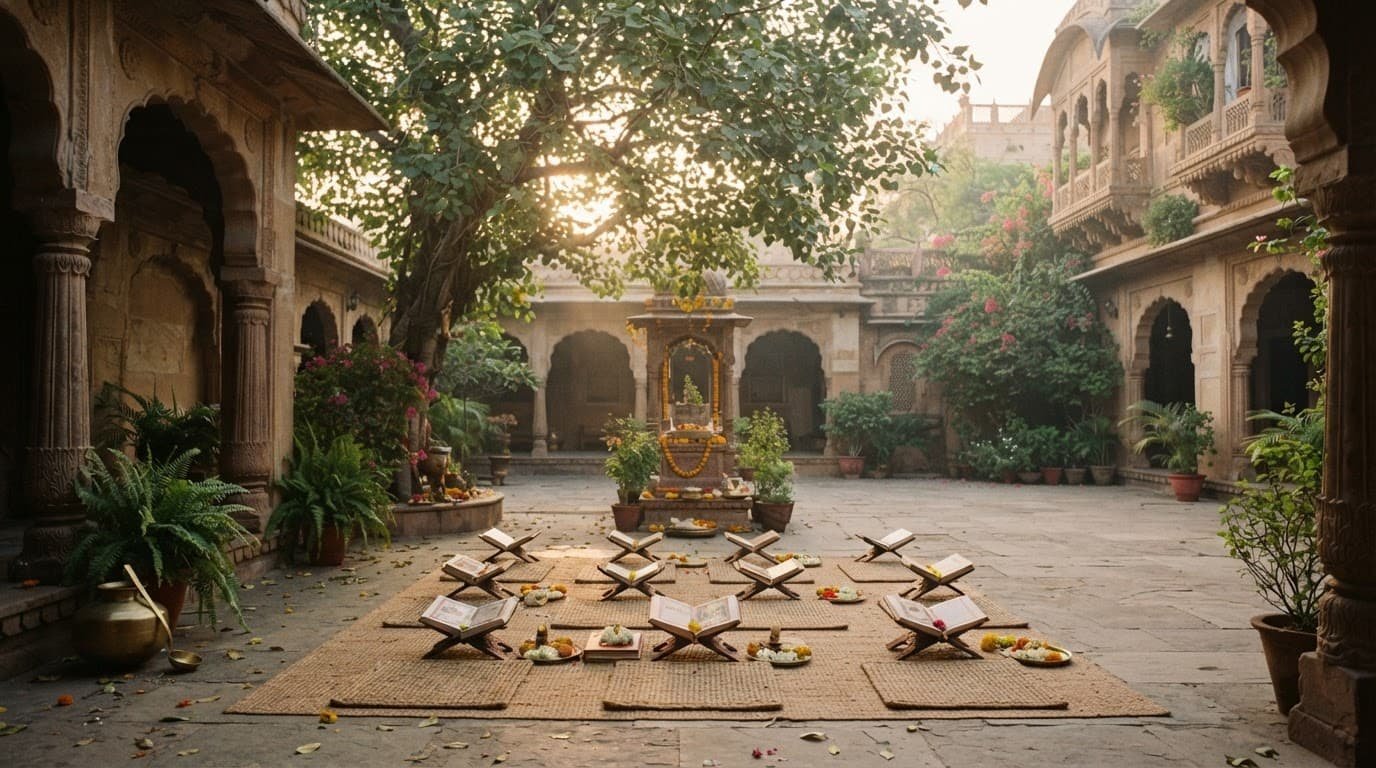
The gathering opens in the traditional mood of the morning program, with glorification of Sri Krishna and Srimati Radharani. The prayers lovingly describe Krishna, the Supreme Personality of Godhead, focusing on His lotus feet, peacock feather, flute, yellow garments, rain-cloud complexion, sandalwood fragrance, and sweet threefold-bending form while chanting the holy name.
Then the heart turns toward Radharani, asking again and again for her merciful sidelong glance and taking shelter of her lotus feet. It is such a tender prayer. Not “make me impressive,” not “give me more stuff,” not even “make my life easy.” Just, “Please let me receive Your mercy.”
The spiritual life begins to soften when the heart stops demanding control and starts asking for service.
The day also honors the appearance of Sanatana Goswami. In the tradition of Gaudiya Vaishnavism, the days connected to great devotees are not treated like distant anniversaries. They are opportunities to remember their character, hear their teachings, and ask for a little of their sincerity to rub off on us. Through his complete surrender, Sanatana Goswami exemplified the core mood of devotional service within Gaudiya Vaishnavism, showing how a follower of Sanatana Goswami finds true freedom in humility.
Sanatana Goswami’s Early Life in Bengal
Traditional accounts place the birth of Sanatana Goswami around 1488 CE. He and his brothers, Rupa Goswami and Anupama, came from a learned Brahmin family, yet their lives became tied to the government of Bengal under Sultan Hussain Shah.
Sanatana held a high post, commonly described as that of prime minister, while Rupa Goswami also held an important ministerial role. Their government names were Sakara Mallik and Dabir Khas, serving directly under Hussain Shah. They had influence, resources, and learning, but Sanatana Goswami never became puffed up by it. He saw his service under a Muslim ruler as a reason to be humble, not a reason to feel superior to anyone.
He studied under the renowned scholar Vidya Vachaspati, delving deeply into sacred scriptures and developing a special love for the Srimad Bhagavatam. It is a sweet contrast, isn’t it? A person can be outwardly surrounded by politics and responsibility while their heart is being watered by Krishna-katha, finding constant refuge in the Srimad Bhagavatam even while working alongside Anupama in demanding administrative duties.
The Secret Meeting at Ramakeli
When Chaitanya Mahaprabhu traveled through Bengal, great crowds gathered around Him. Rupa Goswami and Sanatana Goswami longed to meet Him, but their political situation was delicate, so they came to Ramakeli at night, quietly, with grass between their teeth, a traditional sign of surrender and humility.
They spoke of themselves as fallen because they were employed by people hostile to cows and brahmanas. Their words were intense. They felt trapped in the ditch of worldly life, even while everyone around them considered them successful.
Chaitanya Mahaprabhu did not reject them. He gave them their spiritual names, Rupa and Sanatana, and told them they were His eternal servants. He had come to Bengal, He said, to meet them.
Ramakeli still carries memories of that meeting and remains one of the most cherished holy places for followers. Devotees visit sites connected with Chaitanya Mahaprabhu, the Tamal and Kadamba trees, the sacred ponds, the shrine of Madana Mohana, Rupa Sagara, and the divine spots where Madana Mohana originally manifested.
Leaving Power Behind
After meeting Chaitanya Mahaprabhu, the brothers could no longer feel at home in government life. Rupa Goswami arranged his wealth carefully, giving much of it to Vaishnavas and family members, while keeping a portion aside for future necessity. He then left with Anupama in hopes of joining Mahaprabhu.
Sanatana Goswami took another route. He stopped attending court, saying he was ill, while spending his time studying Srimad Bhagavatam with learned pandits. Hussain Shah soon learned that his minister was not sick at all. Sanatana Goswami had simply turned his attention elsewhere.
The king tried affection. Then pressure. Finally, when Sanatana Goswami refused to accompany him on a military campaign and participate in government service, he was imprisoned.
A message from Rupa Goswami reached him in coded Sanskrit. Its meaning was clear enough: Chaitanya Mahaprabhu had gone toward Mathura, and devotional service was the true call of the soul. The world doesn’t last forever. Make your mind steady.
That was all Sanatana Goswami needed to hear.
Escape, Gold Coins, and the Cost of Freedom
Sanatana Goswami persuaded the jailer to release him, first through appeals, then through the money Rupa had left in safekeeping. The account is not trying to make prison escape into some cute spiritual trick. It shows the urgency Sanatana Goswami felt to leave bondage, seek out Chaitanya Mahaprabhu, and give his life to devotional service.
He crossed the Ganges and traveled through villages and difficult mountain paths with his servant, Isana, toward holy places where saints gathered. Along the way, they met a landowner who was also a robber chief. The man treated them with suspicious warmth because he had learned that Isana carried eight gold coins.
Sanatana Goswami sensed that something was off. When he discovered the coins, he gave them to the landowner in return for safe passage. The man admitted he had planned to murder them for the gold. One lonely coin still remained with Isana, though. Sanatana Goswami asked him to take it and return home.
It is a sobering little moment. Renunciation is not costume play. As a pure devotee dedicated to his spiritual master and wholly absorbed in devotional service, Sanatana understood that if the mind is still clutching a hidden coin, it may not be ready for the road ahead with Chaitanya Mahaprabhu.
Meeting Mahaprabhu in Varanasi
Sanatana Goswami eventually reached Varanasi, where Chaitanya Mahaprabhu was staying with Chandrasekhara. He did not go boldly through the door. He waited outside, dusty, exhausted, with long hair and beard from prison and travel.
Chaitanya Mahaprabhu knew His devotee had come. When Sanatana entered, he fell at the lotus feet of the Lord, and Chaitanya Mahaprabhu rushed to embrace him, beginning to brush the dust from his body. Sanatana protested, feeling unfit to be touched. The Lord answered that touching such a pure devotee purified Him, and Sanatana accepted Him fully as his eternal spiritual master.
Sanatana later shaved, bathed in the Ganges, and refused fresh clothing, accepting his old cloth back. When he continued wearing an expensive wool blanket, Chaitanya Mahaprabhu repeatedly glanced at it. Sanatana got the message. At the riverbank, acting under the guidance of his spiritual master, he traded it for a worn quilt.
Chaitanya Mahaprabhu was pleased. Why keep one last thread of luxury after Krishna has helped someone leave the disease of material attachment behind, a lesson that would later inspire profound devotional literature?
The Questions That Open Spiritual Life
In Varanasi, Sanatana Goswami asked the questions that have been echoing in human hearts for a very long time:
- Who am I?
- Why do the threefold miseries trouble me?
- What is truly good for me?
- How can I reach the highest goal?
He admitted that people thought he was wise, and that he had believed it too. But what did all that worldly intelligence amount to if he did not know his own eternal nature?
Chaitanya Mahaprabhu taught him that the living being is an eternal servant of Krishna, the Supreme Personality of Godhead. This instruction forms the foundational pillars of Gaudiya Vaishnavism through three connected truths: sambandha, our relationship with Krishna; abhidheya, the practice of devotional service; and prayojana, love of Krishna, the soul’s highest treasure.
Chaitanya Mahaprabhu also taught achintya bheda-abheda, inconceivable oneness and difference. The soul is one with Krishna in spiritual quality, yet always distinct as an individual servant of the Supreme Personality of Godhead. It is not a dry philosophy puzzle, and it gives the heart somewhere to stand. We belong to God, but we are not erased by God.
From these teachings, Sanatana Goswami would eventually blossom into a foundational scholar of Gaudiya Vaishnavism, shaping the tradition by writing monumental devotional literature like Brihad bhagavatamrita and Hari bhakti vilasa to guide practitioners in their devotional service.
Sanatana’s Road to Vraja
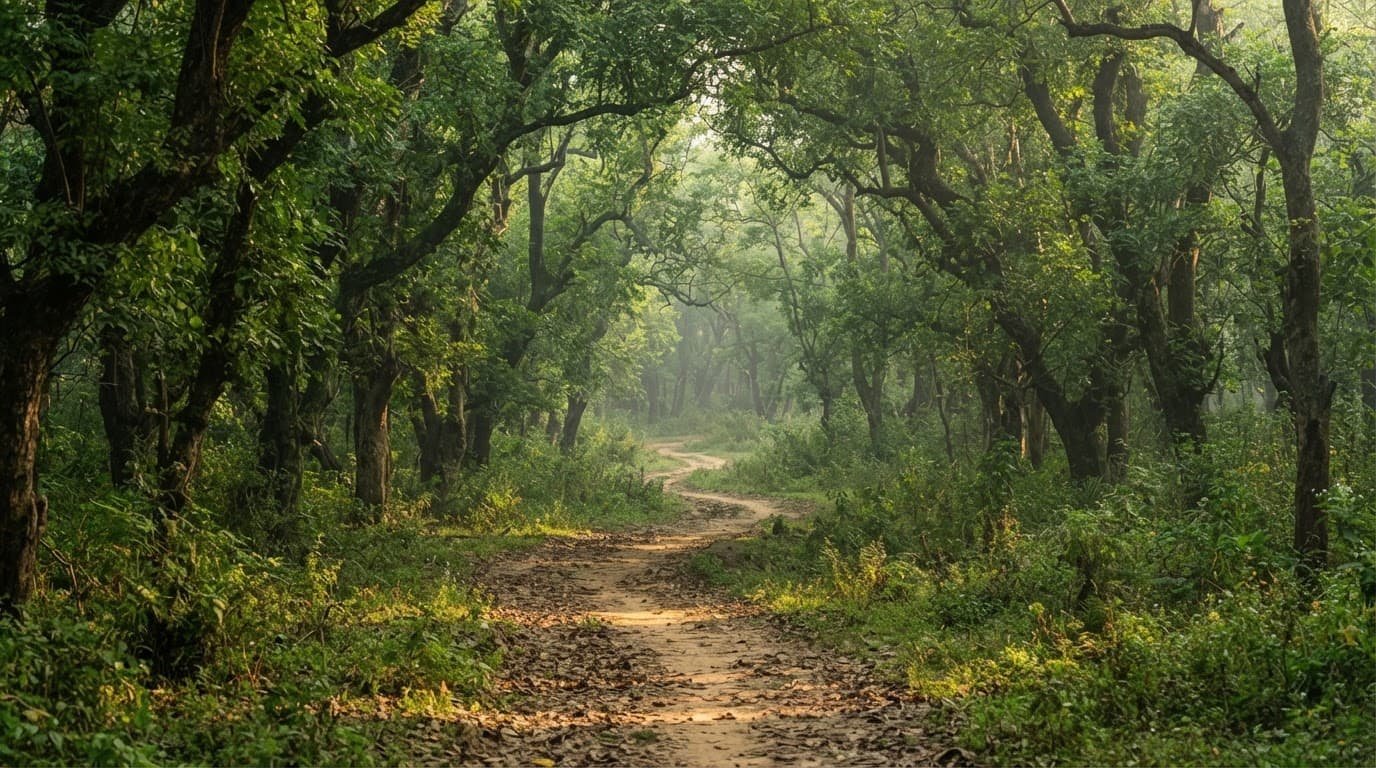
When Mahaprabhu’s teachings were complete, Sanatana Goswami journeyed to Vrindavan. There he met Subuddhi Raya, traveled through the twelve forests of Vraj, and heard news of Rupa and Anupama. While visiting the holy places of the region, Sanatana Goswami performed parikrama of Govardhana Hill and immersed himself in deep remembrance of Krishna pastimes.
He also had darshan of Gopala when the deity had been moved from Govardhana Hill to the village of Gantoli during fear of attack. The Lord’s pastimes have their own strange, beautiful timing. Mahaprabhu had wanted to see Gopala but had vowed not to climb Govardhana. Circumstances brought Gopala down the hill. Later, Sanatana Goswami also received that darshan in the holy places of Vraja.
During his time in Vrindavan, Sanatana Goswami established the worship of the historic Madana Mohana deity, anchoring devotion in the sacred forest. As one of the prominent Six Goswamis of Vrindavan, he spent his days writing profound texts. He composed the Brihad bhagavatamrita, a monumental work exploring Krishna pastimes and the gradual hierarchy of spiritual realms, as well as the Hari bhakti vilasa, which meticulously outlines religious principles and ritual guidelines for devotees. Through these writings, Madana Mohana inspired a lasting legacy that shaped the community in Vrindavan for generations to come.
Frequently Asked Questions
Who was Sanatana Goswami?
Sanatana Goswami was a senior leader among the Six Goswamis of Vrindavan and a primary disciple of Sri Chaitanya Mahaprabhu. Born around 1488 CE, he initially served as a high-ranking minister under the Bengal sultan before abandoning his political career to dedicate his life entirely to bhakti yoga and scriptural scholarship.
Why did Sanatana Goswami leave his position of power?
After meeting Chaitanya Mahaprabhu at Ramakeli, Sanatana Goswami realized that worldly success and political influence were ultimately empty without spiritual realization. He felt a deep urgency to escape worldly bondage, leading him to leave his government post, endure imprisonment, and journey to seek his spiritual master.
What are Sanatana Goswami’s major literary contributions?
Sanatana Goswami authored several foundational texts for Gaudiya Vaishnavism that continue to guide practitioners today. His most notable works include the Brihad bhagavatamrita, which explores spiritual hierarchies and Krishna pastimes, and the Hari bhakti vilasa, a detailed guide on religious principles and ritual practices for devotees.
What core questions did Sanatana Goswami ask Chaitanya Mahaprabhu?
In Varanasi, Sanatana Goswami humbly approached Chaitanya Mahaprabhu by asking fundamental questions about identity, the causes of suffering, true self-interest, and the highest spiritual goal. These inquiries prompted the Lord to outline the essential truths of sambandha, abhidheya, and prayojana.
A Life That Keeps Asking the Real Question
Sanatana Goswami’s life does not ask us to copy every outer detail. Most of us are not escaping a king’s prison or trading a fancy blanket beside the Ganges. But his inner question belongs to every one of us: “Who am I, and what is my real good?”
As a foundational pillar of Gaudiya Vaishnavism, the teachings of Sanatana Goswami invite us to look past temporary titles. He stands foremost among the Six Goswamis of Vrindavan, showing how to live by essential religious principles while immersed in constant prayer and the chanting of the holy name.
He had status and education, yet he asked like a beginner. That humility became his freedom, inspiring a lifetime of spiritual devotion guided by Chaitanya Mahaprabhu. Bhakti begins there, with an honest heart that is willing to stop pretending it already knows the way home, much like the lasting legacy found throughout the sacred groves of Vrindavan.
When Sanatana Goswami finally arrived in Vrindavan, his days were filled with writing texts on Gaudiya Vaishnavism, meditating on Chaitanya Mahaprabhu, and sharing the sweetness of the holy name. His adherence to strict religious principles never felt like a burden, because true spiritual devotion had transformed his entire existence.
Even today, the remembrance of Sanatana Goswami calls us back to simplicity. His journey reminds us that inner freedom is always available when we learn to ask the right questions with a sincere heart.

TLTRExcerpt
TLTR
Excerpt
Learn how Sanatana Goswami left power, escaped prison, and embraced bhakti yoga, becoming a leading scholar among the Six Goswamis of Vrindavan.
Recent Posts
Kirtan Night: Chanting and a Kartik Lamp Offering

Give Miami Day Kirtanathon: Sacred Sound and Shared Devotion
Damodara: Longing for Devotion Beyond Outward Practice
Kamyavan Pilgrimage: Krishna’s Pastimes in Braj
Remembering Srila Prabhupada at Sunday Love Feast
Categories
Share
Recent Posts