JuicyMagiK On the Go
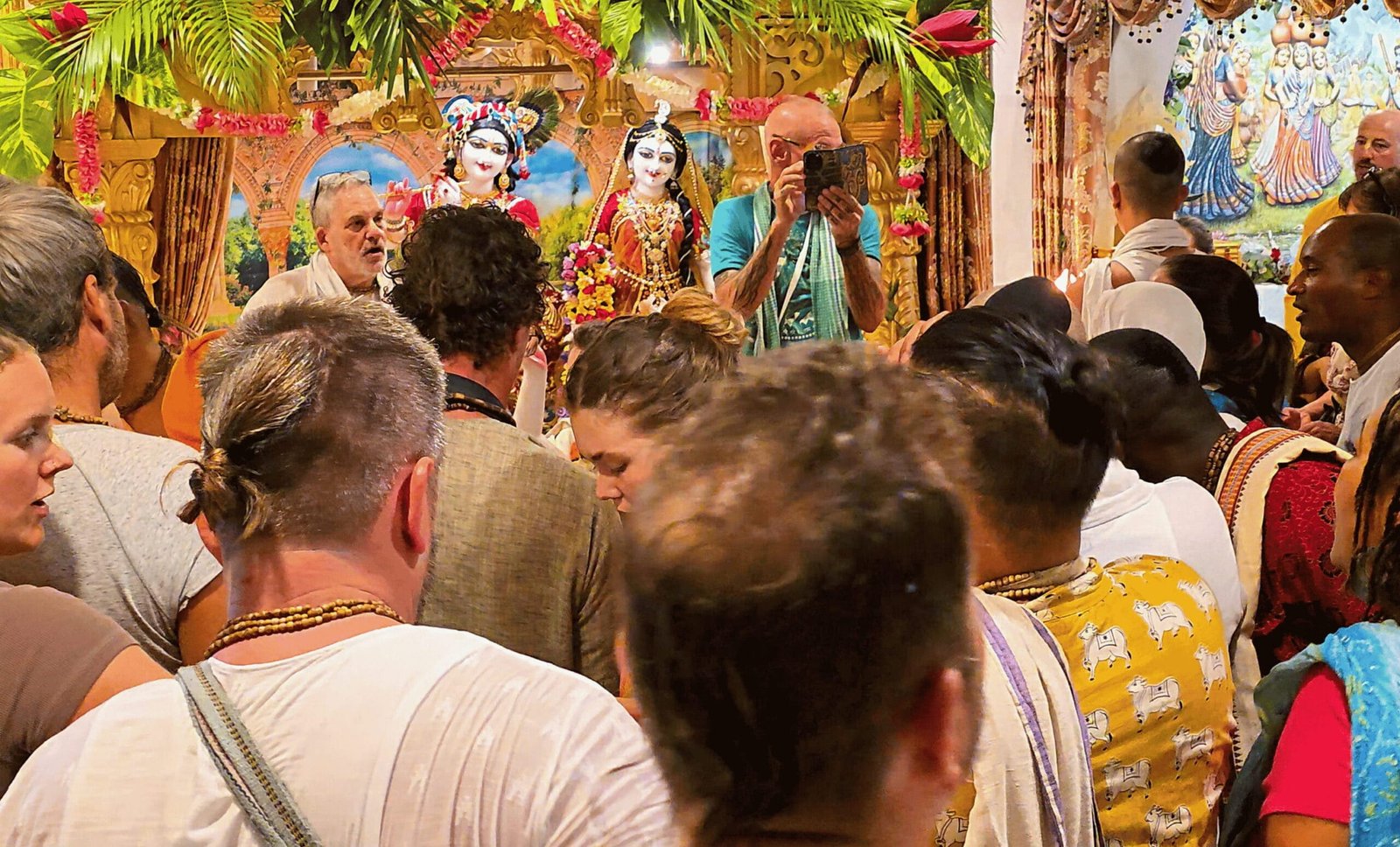
Listen, Watch a Once In a Lifetime Deity Installation Event and Be Blessed
mariakerwin
July 2, 2026
Some videos explain devotion. This one lets you hear a room change.
At Sacred Vedic Arts, a marble deity of Lord Chaitanya from India is being installed, and chant after chant fills the space with a bright, gathered feeling. If you’ve ever wanted to know what bhakti sounds like when nobody is trying to perform and everybody is trying to offer, this is that kind of moment.
Stay with the sound for a little while, and the kirtan starts doing what kirtan does.
A room that becomes alive with devotion
There is something special about a deity installation that can’t be reduced to ceremony in the dry, formal sense. For devotees, it is a welcome. It is a meeting. It is a moment where prayer, sacred form, song, and presence all gather in one place at the same time.
That is why this video feels different from a concert clip or a polished devotional recording. The chanting is not decoration around the event. The chanting is the event. Every repetition of “Jaya Gauranga,” every call of “Jaya Nitai,” builds the atmosphere until the room feels alive with sacred sound.
No polish, no distance, no need to impress, just voices rising together in the holy name.
And honestly, that rawness is part of the beauty here. You can hear human voices being human. Some full and strong, some softer, some carried by the group. Nobody is sanding down the edges. Nobody is trying to package transcendence. It is warm, immediate, and shared.
The setting matters too. A marble deity of Lord Chaitanya has arrived from India, and this installation is being honored in the middle of a room soaked in chanting. For the people there, this is not a symbolic extra added on top of the day. This is sacred action. The names being sung are part of the welcome, part of the offering, part of the way the whole room turns toward something higher.
There is also a sweetness in how ordinary the sound is. No studio sheen. No big production tricks. Just rhythm, repetition, and devotion. That simplicity lets the heart come forward. It is one of the reasons a recording like this carries such a steady and bright feeling from beginning to end.
How the kirtan unfolds, minute by minute
This kirtan moves in waves. It opens gently, gathers strength, widens into melody, and then settles into a softer refrain without ever losing the current underneath.
Here’s the flow of the chant through the video:
- 00:00, “Jaya Gauranga” begins
- 00:30, “Jaya Nitai” starts flowing through the chant
- 01:51, the room turns into “Hari Bol”
- 02:44, the melody opens into “Radha Raman, Hari Govinda” and “Jaya Jaya Gopal, Jaya Jaya Govinda”
- 04:06, the chant shifts into “Radhe Radhe”
- 04:45, the final refrain carries the mood home
At the beginning, “Jaya Gauranga” has that welcoming quality that immediately pulls people in. It is simple enough to join, even if you’ve never heard it before. Then “Jaya Nitai” enters and keeps the same sweet momentum going. The tone is joyful, affectionate, and open. Nothing is rushed.
When the chant turns into “Hari Bol,” the rhythm lands in a stronger way. The room seems to find its feet. This part has a different texture, less like an opening invocation and more like a collective pulse. Repetition here is not empty. It is how attention is gathered, again and again, back to the name.
Then the melody widens. “Radha Raman, Hari Govinda” comes in with “Jaya Jaya Gopal, Jaya Jaya Govinda,” and the chant takes on an even more singable sweetness. Names flow one after the other. The room feels closer together. You can hear how the music and the mantra are working as one thing, not two separate layers.
By the time “Radhe Radhe” arrives, the kirtan has softened without becoming weak. If anything, it gets more inward while still staying fully shared. It feels rounder, like a group breathing in one rhythm. The final refrain does not hit like a hard stop. It lingers, the way incense lingers, or the way a bell still seems to ring for a second after the sound is gone.
Why repetition works in mantra meditation
Some people hear repeated chanting and wonder if it is too simple. That question makes sense, at least at first. We are used to constant novelty, fresh noise, new stimulation every few seconds. So when one sacred phrase keeps returning, the mind may not know what to do with it right away.
Then something lovely starts happening. Instead of chasing the next thing, attention begins to rest. The repeated name becomes a place to return. Not once, but many times. That is one of the quiet mercies of mantra practice. The point is not to impress the mind with complexity. The point is to bring the mind back into relationship with the sound.
If you’re newer to this kind of practice, this simple kirtan overview gives a clear picture of shared chanting as meditation. For a wider devotional frame, this intro to meditation and bhakti yoga offers a gentle starting place.
This video is a good example because nothing is over-explained. You are not being lectured into a mood. You are being invited into repetition. “Gauranga,” “Hari Bol,” “Govinda,” “Radhe,” they keep returning until the sound itself becomes the teaching. Not by argument. Not by analysis. By steady contact.
You don’t need a polished voice to receive kirtan. You only need a willing ear, and maybe a willing heart.
Group chanting also removes a strange pressure many people carry around spiritual practice, the pressure to do it perfectly. In kirtan, nobody has to invent the right words. Nobody has to produce a flawless personal prayer on the spot. The names are already there. The group is already moving. You enter, you listen, you answer, you keep going. That simplicity is not small. It is part of what makes bhakti so accessible and so kind.
How to listen and chant along from wherever you are
One of the beautiful things about a recording like this is that it does not stay trapped in the room where it happened. The event took place at a particular time, in a particular space, during a particular installation, yes. But the chant travels. You can meet it in your living room, on a walk, through headphones, before prayer, after a hard day, or first thing in the morning when your thoughts have not fully started sprinting yet.
A gentle way to approach it is simple:
- Find a quiet spot, or at least a few unhurried minutes.
- Let the rhythm settle before deciding what you think about it.
- Chant along if you want, even softly.
- Keep your attention on the sound, not on perfect pronunciation.
That last point matters. This is not about getting every syllable museum-perfect. The whole feeling of the video says the opposite. The offering is what matters. The sincerity is what matters. If all you do is listen, that is already participation. If the names start to rise from your own mouth after a minute or two, even better.
The repeated phrases make it easy to join. “Gauranga” can ride the breath. “Hari Bol” can anchor the mind. “Radhe Radhe” can soften the heart when things feel dry, tight, or a little overcooked by life. Not every meditation practice works for every mood, but kirtan has this generous quality. It meets people where they are.
And if you come back to this video more than once, that makes sense too. Some chants are like companions. You revisit them because the room they create in you is a good room to sit in.
If you want to stay connected with this current
Part of what feels good here is that the chant does not live in isolation. It is connected to real people, real practice, and a real devotional community. If this kirtan stirs something in you, the Juicy Magik Agora community portal is a natural place to share appreciation or ask a sincere question.
There is also a practical side to keeping this kind of work going. Sacred sound, events, travel, recordings, teaching, community spaces, all of that takes support. If you want to help sustain the wider work around devotional life and related projects, the Juicy Magik projects page gathers those support options in one place.
That feels fitting, honestly. Bhakti is not only what happens in a peak moment when the room is singing. It is also what happens after, when people stay connected, keep showing up, and help carry the work forward in ordinary ways.
When the chant keeps going after the video ends
Some recordings ask you to watch. This one asks you to listen until the space around you, and maybe the space inside you, shifts a little. That is the gift of sacred sound here, not performance, but presence.
The names move from Gauranga and Nitai to Hari Bol, Govinda, Gopal, and Radhe. Somewhere in that repetition, the mind gets quieter and the heart gets a little more available. The video ends. The refrain doesn’t have to.

TLTRExcerpt
TLTR
Excerpt
Listen to a once in a lifetime deity installation with Gaurang, Hari Bol, and Radhe Radhe chants and experience the blessings of this sacred ceremony.
Recent Posts
Listen, Watch a Once In a Lifetime Deity Installation Event and Be Blessed

A Crab Got Us 1,200 Views, So We Had to Thank the Crabs

Our Tiny Van Morning in Greece, Tea, Chanting, and the Not-So-Glam Side of the Road
A Tiny Chapel, Big Peace, and the Sweet Truth About Jesus We Don’t Hear Enough

Meteora Stole Our Hearts, Ancient Monasteries, Gentle Nuns, and Pure Peace
Categories
Share
Recent Posts