Sacred Vedic Arts
Held during the sacred month of Ashadha, this annual festival is not only about a great chariot moving down a road. In the mood given by Sri Caitanya Mahaprabhu, this famous Festival of the Chariots tells the story of love pulling Krishna back to Vrindavan.
This morning program moved through kirtan, prayer, and a tender reading about Krishna’s reunion with the gopis at Kurukshetra. The thread running through it all was simple and enormous: Krishna is moved by love.
Key Takeaways
- Ratha Yatra is deeply understood in the tradition of Sri Caitanya Mahaprabhu as a festival of love pulling Krishna back to Vrindavan.
- The morning programs combine kirtan, prayers, and sacred readings to ground daily life in spiritual sound and devotion.
- The journey of Lord Jagannath, Balabhadra, and Subhadra mirrors the emotional landscape of Krishna’s reunion with the gopis at Kurukshetra.
- Srimati Radhika and the residents of Vraja desire simple, intimate love rather than the royal splendor and opulence of Kurukshetra.
- True devotion, or uttama-bhakti, is driven by spontaneous affection and longing (raganuga-bhakti) rather than mechanical rules.
A Morning of Kirtan, Prayer, and Sacred Reading
The gathering began in the familiar, sweetly imperfect way of a real morning program. Devotees opened songbooks, found pages, and then found them again. Some prayers moved more slowly, some doubled in pace, and kartals passed from hand to hand.
There was room for questions, page-turning, little bits of daily life, and the steady return to the holy names. That is part of the beauty. Devotion isn’t floating above ordinary life. It happens right in the middle of it, with a songbook slipping off a bookstand and someone kindly helping you find the next page. Often following the spiritual blueprint established by Srila Prabhupada and carried forward across ISKCON centers worldwide, these morning sessions ground the day in sacred sound.
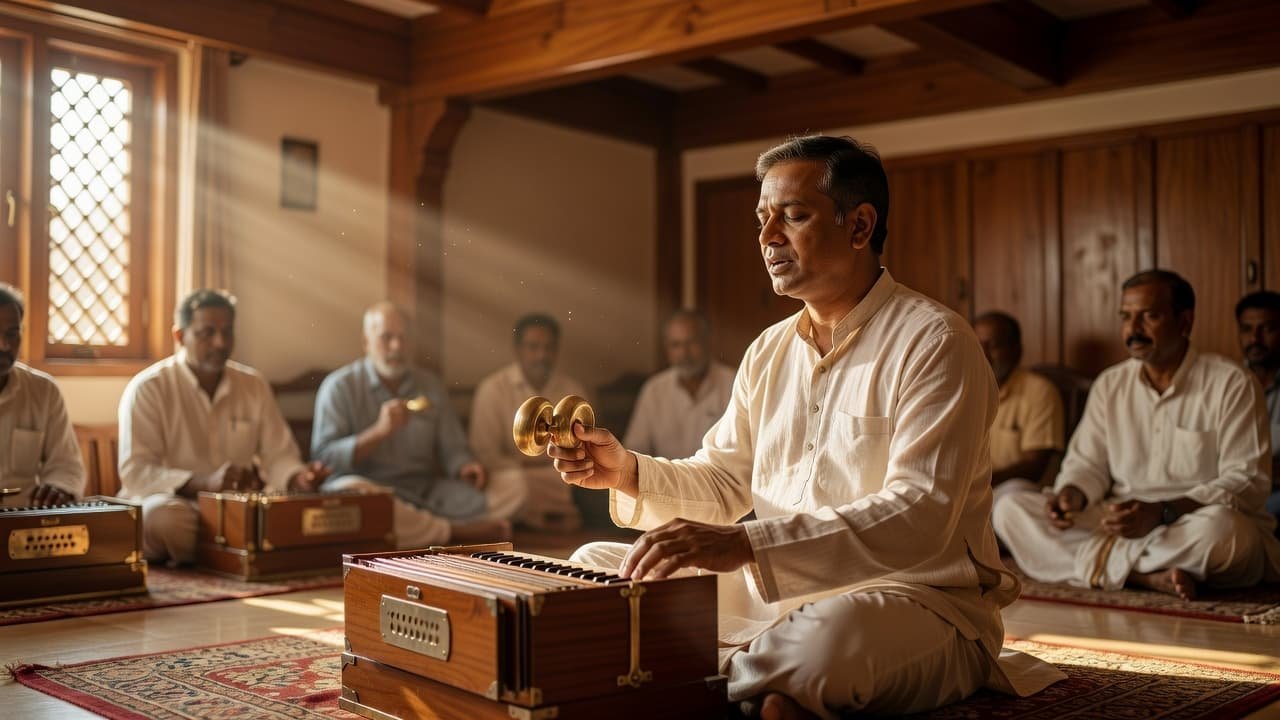
One song glorified Nitai and Gaurachandra as supremely merciful, the source of bliss, and the crown jewels among all incarnations. Its prayer is not complicated: turn away from the things that keep the heart scattered, and take shelter in Their worship.
Even birds, animals, and stones are said to melt on hearing the glories of Nitai and Gaurachandra. The heart is not too ordinary for sacred sound.
That may sound poetic, but anybody who has sat in a good kirtan knows the little mystery of it. A room can feel heavy, distracted, or tired, then one sincere melody rises and something softens. Holy names have been sung in every kind of place, in every kind of human weather.
The invocation prayer also gave a humble starting point: affected by material activity, troubled by envy, and falling into an ocean of humility, we seek shelter. Not pretending to be pure. Starting where we are.
Why Jagannatha Travels to Gundicha
The heart of Ratha Yatra is the journey of Lord Jagannath, along with His brother Balabhadra and sister Subhadra, from His great temple in Puri to the Gundicha Temple. In this reading, the Gundicha Yatra is understood as a movement toward Vrindavan, the place of Krishna’s most intimate, sweet pastimes with the residents of Vraja.
Once a year, Jagannatha feels separation from Vrindavan and the gopis. He manifests a fourteen-day illness, accepting simple kitchari and herbs, then prepares to leave His palace. Lakshmi Devi is told He will only be gone a few days. Ah, Krishna. A few days, he says.
The grand procession carries a particular mood. It is not the formal mood of being invited somewhere because the rules say you may go. It is more like the sudden pull in the heart: “I have to go to my friend’s house. I have to see them.”
That spontaneous pull is a little window into the distinction between vaidhi-bhakti and raganuga-bhakti. Vaidhi-bhakti follows scriptural rules and reverence. Raganuga-bhakti is stirred by spontaneous affection and longing. Both are bhakti, but the mood of Ratha Yatra is full of that longing: Krishna must return to Vraja.
Sri Caitanya Mahaprabhu showed the hidden meaning of this journey through His dancing and singing. Jagannatha is Krishna, returning toward the love of the gopis. Mahaprabhu is Srimati Radhika’s love in motion, drawing the deities onward.
The Reunion at Kurukshetra
The Ratha Yatra mood is tied to Krishna’s meeting with the gopis at Kurukshetra, many years after He left Vrindavan. Such massive gatherings during a solar eclipse held immense significance in ancient Vedic culture, bringing kings, sages, royal families, and pilgrims together. Shree Jagannatha knew the news of this event would reach Vraja.
When Nanda Maharaja, Mother Yashoda, and the residents of Vraja arrived, Krishna and Balarama could not remain composed in the huge royal assembly. They ran to their parents. There were tears everywhere, the kind that come when love has been waiting far too long.
The gopis had held onto Krishna’s promise that He would return soon. What was meant to be a brief separation had stretched into decades. Yet their love had not become old. It remained ever-fresh.
Uddhava had earlier come to Vrindavan as Krishna’s dear friend and adviser, but he came to understand that the gopis’ love was beyond what he knew. Krishna sent him there to enter, even a little, the school of prema.
The gopis’ separation is not the same as our ordinary loneliness. It burns, yes, but it is filled with the ecstasy of love. Their entire being remembers Krishna. Their eyes, breath, speech, and life-airs belong to Him.
“Come Back With Us to Vrindavan”
Sri Caitanya Mahaprabhu would recite a verse from ordinary Sanskrit poetry about meeting the same beloved again, under the same moonlight and fragrant flowers, yet feeling unhappy in that new place. The longing was for the old riverbank, the old grove, the first intimacy of love, much like the deep emotional landscape witnessed during every Ratha Yatra festival.
Srila Rupa Goswami understood Mahaprabhu’s inner meaning and gave it its eternal form. Srimati Radhika meets Krishna at Kurukshetra, yet she does not want royal splendor, armies, elephants, queens, or a palace. She wants Vrindavan.
She wants the Yamuna’s banks. Kadamba trees. The sound of cuckoos. Peacocks dancing. A place where Krishna and the gopis could speak freely, play on swings, steal one another’s things, laugh, sulk, and meet without all the weight of royal life around them.
The gopis remember Krishna’s flute. They remember hiding it and watching Him search everywhere for it. They remember how happy He became even when He lost a game. They remember Srimati Radhika’s red lac leaving the mark of her foot upon Krishna.
This is not a rejection of Krishna. It is love asking Krishna to come fully home.
The gopis make their hearts into a chariot and ask Him to sit there. “Come with us to the place where our hearts live. We will never give You up.”
When Jagannatha’s Cart Will Not Move
During Ratha Yatra, Jagannatha’s chariot is pulled with great effort. Strong servants guide Him, ropes are drawn tight, and the Lord is brought onto the massive chariot amid kirtan and crowds.
Yet the sweetest part is this, when Mahaprabhu danced behind the procession, Jagannatha’s cart would stop. Elephants could not move it. Many people could not move it. Then Mahaprabhu came forward, placed His head against the cart, and it began to roll.
This inner devotion echoes across the globe today, from the vibrant streets of San Francisco and Los Angeles, where vibrant cultural performances accompany the grand Bahuda Yatra return journey, down to the deepest movements of the soul.
The mood is that Krishna will not go to Vrindavan without Srimati Radhika. He is drawn by the love of the gopis, and most fully by Her love.
Before Mahaprabhu’s appearance, the festival had devotion, but this inner mood was not openly given in the same way. Mahaprabhu brought kirtan, dancing, tears, and the confidential sweetness of the gopis’ call to Krishna, “Come back.”
Separation Begins With Guru and Vaishnavas
The aim spoken of in the class was not merely to know the story. It is to develop a feeling of separation for Radha and Krishna, beginning with separation from Sri Gurudeva and the Vaishnavas.
The gopis see Lord Jagannath after so many years and take Him into their hearts through their eyes. In that inner embrace, they become absorbed in Him in a way even great yogis struggle to attain.
Krishna tries to console them by speaking of His all-pervading nature. He says He is inside and outside all beings, as clay is present in every clay vessel. Why feel separated, He asks, when He is everywhere?
But the gopis are not impressed. With loving anger, they remember the little boy who stole butter, denied eating dirt, played His flute to call them, and begged forgiveness at Radhika’s feet. “You are not some distant God to us,” their hearts say. “We know You.”
Their love has no desire for wealth, liberation, prestige, or even their own happiness. This is the meaning of uttama-bhakti, which is service offered only for the pleasure of the divine deities and Krishna Himself.
Frequently Asked Questions
What is the deeper meaning of Ratha Yatra?
Beyond being a grand chariot procession, Ratha Yatra represents Lord Jagannath’s journey from Puri to the Gundicha Temple, symbolizing Krishna’s return to the intimate love of the gopis in Vrindavan.
How does the festival relate to Kurukshetra?
The Ratha Yatra mood is tied to Krishna’s emotional reunion with Nanda Maharaja, Mother Yashoda, and the gopis at Kurukshetra, where decades of longing culminated in tears of pure love.
Why did the gopis want Krishna to leave Kurukshetra?
The gopis longed for the simple, sweet pastimes of Vrindavan—such as playing on swings and hearing His flute—without the distractions of royal splendor, armies, and palaces.
What is the significance of the chariot stopping during the procession?
Historically, when Jagannatha’s heavy cart would miraculously refuse to move despite the efforts of elephants and crowds, Sri Caitanya Mahaprabhu would press His head against it, causing it to roll forward through the power of love.
The Pull of Love
Ratha Yatra gives us a chariot, a road, ropes, drums, tears, and a very tender secret. Krishna, who can move the whole universe, allows Himself to be moved by love.
Bhakti begins with service, remembrance, chanting, and the company of devotees. Bhakti-rasa is the taste that awakens when love becomes personal, living, and full of relationship.
May the heart become a little more like that chariot, a place where Shree Jagannatha is welcomed home, again and again.

TLTRExcerpt
TLTR
Excerpt
Explore Ratha Yatra’s spiritual meaning through Sri Caitanya Mahaprabhu’s vision, kirtan, and the gopis’ longing to bring Krishna back to Vrindavan.
Recent Posts
Remembering Srila Prabhupada Among the Trees On His Appearance Day
A Dying Squirrel Heard the Hare Krishna Maha-Mantra
When Coyotes Join the Hare Krishna Maha Mantra Chant
Can Rabbits Hear the Hare Krishna Maha Mantra? One Evening Chant in Southern Ontario

We Chanted With Seals, Then Nearly Burned Our Toes
Categories
Share
Recent Posts