Sacred Vedic Arts
Ratha Yatra, also known as the Festival of the Chariots, is not only a celebration of beautiful chariots, flowers, kirtan, and many happy people. In Sri Caitanya Mahaprabhu’s heart, it is the story of Krishna returning to Vrindavan, and of the love that could not forget Him, even after years of separation, which the devotees experience deeply during this time.
This is a tender meditation on Jagannatha’s form, the gopis’ love, Uddhava’s humbling visit to Vraja, and the moment Krishna finally sees Nanda Baba and Mother Yashoda again.
Key Takeaways
- Ratha Yatra is spiritually experienced through Sri Caitanya Mahaprabhu’s vision of Lord Jagannatha as Krishna returning to Vrindavan with the unconditional love of the gopis.
- Uddhava traveled to Vrindavan to console the Vrajavasis but was deeply humbled, realizing that the gopis’ pure love for Krishna far surpassed his own spiritual knowledge.
- A rare solar eclipse brought an emotional reunion at Kurukshetra, uniting Krishna with Nanda Baba, Mother Yashoda, and the devoted residents of Vrindavan.
- Mother Yashoda graciously stepped aside to allow Srimati Radharani and the gopis to finally approach Krishna after enduring years of painful separation.
Jagannatha Is Shyamasundara Remembering Vrindavan
The Ratha Yatra festival is often seen through the sweet mood of Sri Caitanya Mahaprabhu dancing before the chariot of Lord Jagannath. Yet Mahaprabhu did not see Lord Jagannath merely as the majestic Lord of Puri, or as Krishna in His royal Dwarka mood. He saw Vraja-nandana Sri Krishna, Shyamasundara, the cowherd boy of Vrindavan.
Several histories describe how these sacred deities appeared. One tells of King Indradyumna Maharaja. Another brings us to Dwarka, where Narada Muni praised Krishna’s queens so enthusiastically that they began asking Rohini Devi about Vrindavan. Why was Krishna so drawn there? What was this love of the gopis?
As Rohini spoke, Krishna came near to listen. Subhadra stood at the entrance, and Krishna and Balabhadra heard the stories of Vrindavan from outside. Krishna’s heart melted in remembrance of the Vrajavasis, especially the gopis. This melting mood is connected with the wonderful form of Jagannatha, Balabhadra, and Subhadra.
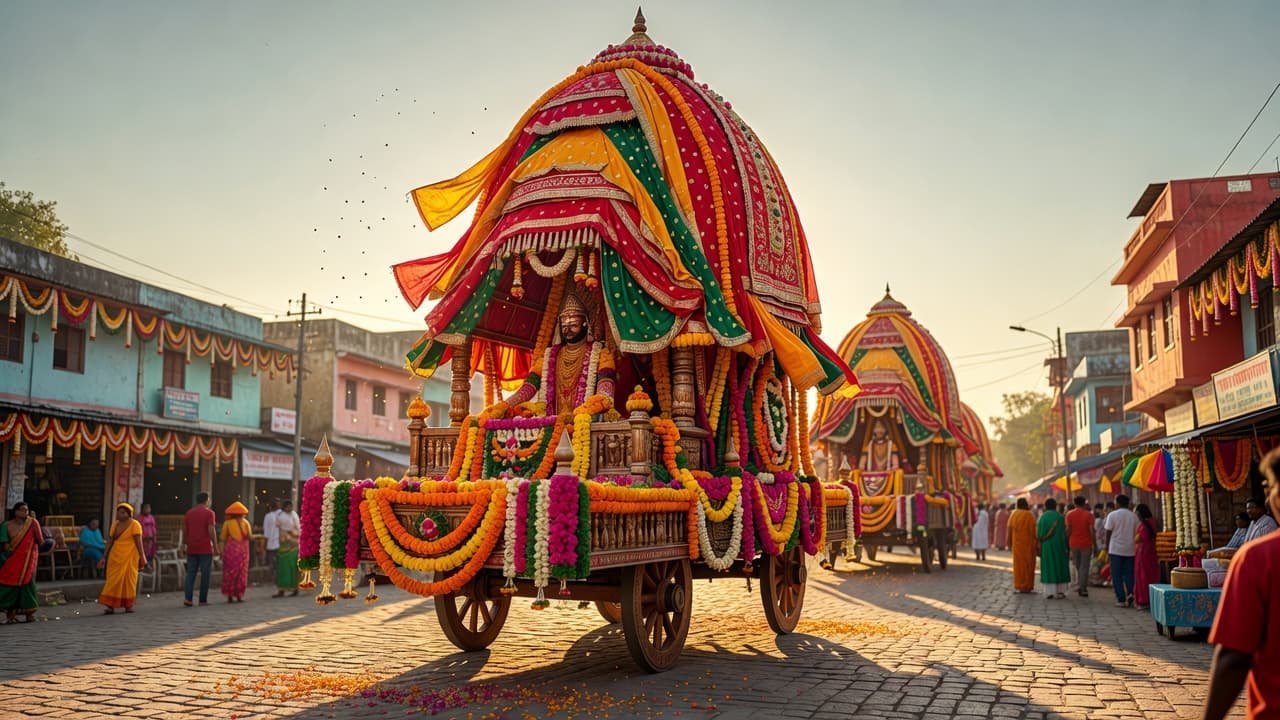
A third history carries an even more intense mood of separation, centered on Srimati Radharani’s pain when Krishna is far away. It is spoken of as something held within the hearts of pure devotees, not something to toss around casually. Some truths are like that. You come close with bare feet.
Mahaprabhu’s Prayer Reveals the Heart of Ratha Yatra
At the beginning of this annual festival, Mahaprabhu offers prayers to Krishna. One verse begins with jayati jana-nivaso. On the surface, it praises Krishna as the shelter of all beings, the son of Devaki, and the leader of the Yadu dynasty. But there is more tucked inside it. So much more.
The word jana can refer to all living beings, because Krishna lives in everyone’s heart as Paramatma. It can also mean His own dear people, His nija-jana. In Vrindavan, Krishna is the very life-air of Nanda Baba, Mother Yashoda, the cowherd boys, the cows, and above all, the gopis.
For the Vrajavasis, there was only one real suffering: separation from Krishna. His flute, smile, playfulness, and presence removed every other sorrow. When He left, the whole of Vrindavan felt empty.
Mahaprabhu saw Jagannatha as Krishna who had left Vrindavan, and He longed to bring Him back to the forest bowers, the flute, the peacock feather, and the love of the gopis.
Mahaprabhu’s prayer, gopi-bhartuh pada-kamalayor dasa-dasanudasah, gives the direction of the heart. We aren’t ultimately defined by nationality, social role, work, family position, or even an outer spiritual identity. Sincere devotees understand that we are meant to become servants of the servants of the lotus feet of Krishna, the beloved of the gopis, especially as we gather for the chariot festival each year.
Uddhava Enters the School of the Gopis
Krishna left Vraja when He was still young, went to Mathura, and later to Dwarka. The gopis waited. Nanda and Yashoda waited. The cows, calves, birds, trees, and forests of Vrindavan waited. Krishna was separated too, but He carried that sorrow alone.
He sent Uddhava to Vrindavan with a message of consolation. Uddhava loved Krishna dearly and was learned, wise, and intimate with Him. Still, he had not yet understood the kind of love that lived in Vraja.
The gopis had let go of ordinary bodily concerns:
- They no longer decorated themselves.
- They had little interest in eating, bathing, or sleeping.
- Their hearts were fixed on Krishna and His well-being.
They weren’t asking, “Why has He left us?” Their concern was, “Who is feeding Him? Is He hungry? Who notices when He needs rest? Mother Yashoda isn’t there to care for Him.”
Srimati Radharani’s separation was unbearable. She prayed that if she died, her body might rest near a tamal tree, which carries Krishna’s dark-blue color. She wanted every element of her body to somehow touch Him, water joining the ponds where He bathed, air reaching Nanda Baba’s courtyard, sunlight touching His skin. This is not ordinary longing. This is love with no thought of itself.
Uddhava arrived thinking he would teach. Instead, he became a student. He saw the gopis’ love as a mountain so high that, as the sweet image goes, his hat fell from his head as he looked upward. His entrance-exam score in their school of prema was only about 25 percent, while the gopis required more than 85 percent. Oof. Humbling.
He prayed for the dust of their lotus feet, even to be a bush or creeper in Vrindavan so that their foot dust might fall upon him. Among all devotees, the great Uddhava came away knowing that love for Krishna reaches its highest expression in the gopis, and most fully in Srimati Radharani.
A Solar Eclipse Brings Everyone to Kurukshetra
Years passed, and a rare solar eclipse during the holy month of Ashadha brought kings, sages, and pilgrims to Kurukshetra. Krishna came with His queens, armies, and royal associates. Nanda Baba somehow heard of the gathering and could not remain in Vraja. The gopas and gopis prepared their bullock carts, carrying butter and other things Krishna loved, forming a devoted procession that traveled across the miles.
During an eclipse, people traditionally bathed and gave charity. The description is almost wild in its generosity, with kings giving gold, utensils, clothing, and wealth until people who had received charity began giving charity to others. What a mood. Everyone was satisfied because Krishna was there, turning the massive gathering into a sacred festival of the heart.
Kurukshetra filled with sages, rulers, relatives, and huge crowds. Kunti met her brother Vasudeva and wept, remembering the suffering of her sons and the cruelty they had endured. Vasudeva answered with his own sorrow, recalling imprisonment under Kamsa and the loss of six sons.
Their meeting holds a sober reminder. Life contains meetings and separations, prosperity and pain. None of us controls every turn. Yet the heart can still remember love across long distances and impossible circumstances.
Krishna Runs to Mother Yashoda and Nanda Baba
Then someone told Krishna and Baladeva, “Your father and mother are coming in a bullock cart.”
Krishna left the great assembly at once. Sages were there. Kings were there. Thousands upon thousands of people had come for His darshan, holding onto the ropes during the chariot pulling just to catch a glimpse of the Lord. But He ran, weeping, toward Nanda Baba and Mother Yashoda.
When Yashoda saw her son, years of separation poured out as tears. Krishna sat on her lap as if He were again her small child, revealing Himself as the supreme object of devotion, yet still acting as the beloved living deities of her very heart. She covered His face with affection, and milk flowed from her breasts. Nanda Baba held Baladeva. Krishna cried, “Mother!” Baladeva cried, “Father!”
Devaki watched this scene with mixed feelings. Krishna had not sat on her lap in this way. He had not called her “Mother” with this same helpless sweetness. She praised Yashoda for raising Krishna as her own and protecting Him as eyelids protect the eyes. Yet behind her words was a mother’s ache.
Rohini understood. She gently drew Devaki and Vasudeva away to greet the many visitors, protecting the precious reunion from interruption.
Yashoda Makes Space for the Gopis
Mother Yashoda then remembered something. Nearby stood Radharani, Lalita, Vishakha, and all the gopis. They had carried their separation through the long journey from Vrindavan, somehow holding themselves together. But now Krishna was near, and they still could not approach Him.
The feeling was compared to carrying a bundle of fresh green chickpeas. At first it feels light. Halfway home, it grows heavy. At the doorway, you cannot take one more step and the bundle falls from your hands. This profound longing mirrors the emotional journey of devotees as the deities travel toward the Gundicha Temple, or as they eventually prepare for the return journey during Bahuda Yatra.
That was the gopis’ separation. It had become too heavy to bear.
Yashoda knew they needed Krishna. With great generosity, she took Baladeva’s hand and left with Nanda Baba, making room for the gopis to come forward. The story pauses there, right at the edge of their meeting. Oh my gosh. What tenderness.
Frequently Asked Questions
What is the spiritual significance of Ratha Yatra beyond the festival celebration?
While Ratha Yatra is celebrated with magnificent chariots, kirtan, and joyful crowds, Sri Caitanya Mahaprabhu viewed it internally as the poignant story of Krishna returning to Vrindavan and the deep separation felt by His devotees.
Why did Uddhava visit Vrindavan, and what did he learn?
Krishna sent Uddhava to Vrindavan to comfort the grieving Vrajavasis with a message of consolation. Instead of teaching them, Uddhava was profoundly humbled by the gopis’ selfless love, realizing they possessed the highest standard of devotion.
How did the reunion at Kurukshetra take place?
A rare solar eclipse drew kings, sages, and pilgrims to Kurukshetra, prompting Nanda Baba, Mother Yashoda, and the gopas and gopis to travel there with butter and other beloved items. Upon hearing of their arrival, Krishna immediately ran, weeping, to embrace His foster parents.
Love That Never Forgets
Ratha Yatra carries us toward this one aching, beautiful point: Krishna belongs to the love of Vrindavan, and the residents of Vrindavan live only for Him. Mahaprabhu danced before Lord Jagannath and His chariot with that longing in His heart.
Uddhava’s humility, Yashoda’s motherly love, Devaki’s ache, and the gopis’ unwavering remembrance all point toward prema, love that asks for nothing and gives everything. This very spirit of devotion was brought to the modern world through the global efforts of ISKCON, allowing seekers everywhere to share in that same divine longing.
At Kurukshetra, the road is full of chariots, crowds, and royal splendor. Still, the heart is looking for a simple cowherd boy with a flute, waiting to come home.

TLTRExcerpt
TLTR
Excerpt
Discover the heart of Ratha Yatra: Krishna’s reunion with Nanda and Yashoda, Uddhava’s humility, and the gopis’ devotion to Krishna.
Recent Posts
Remembering Srila Prabhupada Among the Trees On His Appearance Day
A Dying Squirrel Heard the Hare Krishna Maha-Mantra
When Coyotes Join the Hare Krishna Maha Mantra Chant
Can Rabbits Hear the Hare Krishna Maha Mantra? One Evening Chant in Southern Ontario
We Chanted With Seals, Then Nearly Burned Our Toes
Categories
Share
Recent Posts