Sacred Vedic Arts
A morning program doesn’t need to be polished to be holy. Morning chanting begins with a few voices, a harmonium, a bell, a well-loved songbook, somebody calling out a page number, and suddenly the room has become a little temple.
This gathering moved through morning prayers, chanting, laughter, remembrance, and affectionate attempts to keep up with the next song. At its heart were devotion and a Triple Gem of spiritual life: sincere prayer, shared remembrance, and joyful song. It was devotional life as it often is, sweet, imperfect, musical, and full of heart.
Key Takeaways
- Morning chanting does not need to be polished; sincere voices, shared remembrance, and joyful song can turn an ordinary room into a sacred gathering.
- Prayer gives honest shape to spiritual longing, including the desire to overcome material attachment, purify the mind, and receive divine mercy.
- Guru-seva begins with humility, sincere questions, faithful listening, and service offered through one’s whole life.
- Sanatana Goswami’s compassion and service to Madan Mohan show that even simple offerings can become expressions of deep love.
- A steady morning practice of chanting, prayer, gratitude, and kindness helps keep the heart oriented toward devotion and a holy life.
A Room That Wakes Up by Singing
The morning opened with sacred music and repeated names of God. Morning chanting carried Krishna, Hare Krishna, Guru, and familiar sounds of praise through the room, sometimes with bells, sometimes with a soft pause, sometimes with everyone trying to find the right place in the book. The vocal rhythm had the steady, attentive quality of Pali chanting, even as the words and tradition belonged to this gathering.
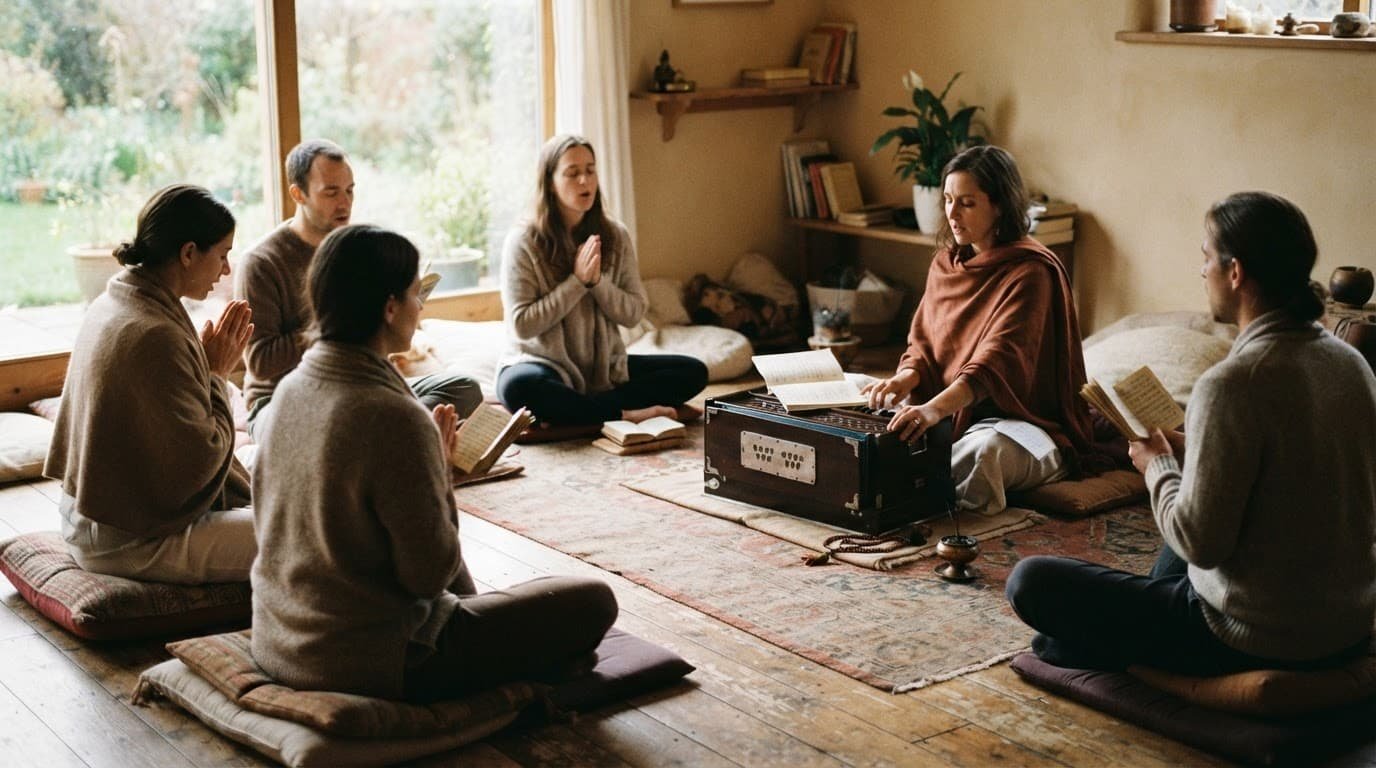
The group moved through pages 23, 36, 86, 114, 200, and 364. Those numbers became little stepping stones through the morning. The songbook served as a simple Chanting guide, much like the shared texts used in Thai Buddhist chanting, helping lay practitioners follow along even when the next page took a moment to find.
There was even a sweet moment of humor around reaching page 200, as though everyone watching a livestream might also be straining, laughing, and thinking, “Are we going to make it?”
People are trying. The book is big. The morning is moving. God is patient.
That is part of the beauty of kirtan. You don’t have to arrive already peaceful or already focused. You bring the restless mind, the sore body, the awkward voice, the whole pile of it. Then you give the senses one clear place to go, the holy name, and let mindfulness grow through repetition.
A drum on the table. A bell. Your palms. Your voice, which costs nothing and rings forever in the places where it matters most.
Prayers That Don’t Pretend We Are Already There
Several readings carried the mood of longing. Not, “Look what I have achieved,” but, “When will my heart become soft enough to receive this?” Human limitations remain visible here, along with the suffering and stress that arise when the mind clings to material desires.
One prayer asks when the hairs on the body will stand up while chanting the holy name, when tears will come to the eyes, and when Lord Nityananda’s mercy will arrive. It asks when material desires will become small, when the mind will be purified, and when Sri Vrindavan will be seen. In the language of the Blessed One, such purification might be connected with seeing clearly through the five aggregates, but these prayers direct that longing toward loving service and divine mercy.
The questions are simple, but they don’t let us hide.
- When will chanting bring tears rather than distraction?
- When will the pull of material enjoyment, with all its suffering and stress, lose its grip?
- When will the mind become clean enough to remember God and begin a holy life?
- When will Vrindavan become more than a faraway holy place or a nice idea?
The prayer places every hope at the lotus feet of Sri Rupa Goswami and Sri Raghunatha dasa Goswami. Their mercy is sought not for wealth or liberation, but for a glimpse of the love of the Divine Couple. This is an aspiration toward Awakening, expressed through devotion rather than self-reliance, and it recalls how the Blessed One praised the clarity of the Noble disciples who had moved beyond ordinary attachment.
“Their necks gently tilted toward each other,” the reading says, describing Radha and Krishna with such tenderness that the heart almost wants to look away and let Them have Their privacy.
Another prayer longs for bodily self-conception to disappear, for the spiritual beauty of Vraja to be seen, and for service in the mood of a Vraja gopi. It is not a small prayer. It asks for a whole new way of seeing, a whole new self, and the courage to let ordinary identity fall away before the heart can fully serve.
Guru-Tattva: The Door That Opens the Other Doors
The reflections then turned toward guru-tattva, the truth and position of the spiritual master. There are many subjects in bhakti: the holy name, Radha and Krishna, Nityananda, Balarama, jiva-tattva, and bhakti-tattva. Across traditions, spiritual knowledge is received through a trusted teacher lineage, much as Dhamma teachings are preserved through the guidance of experienced Sangha disciples.
That can feel a little intimidating. If the foundation is so vast, where do we begin?
With the instructions given in Bhagavad-gita: approach a spiritual master with humility, sincere questions, and service. This spirit also resonates with the refuge of the Triple Gem, the Buddha, Dhamma, and Sangha, and with the heart of Buddhist practice. The supreme teacher is remembered as Rightly Self-awakened, while students learn through formal guidance, careful listening, and faithful practice.
The process is not meant to be cold or mechanical.
- Come with a submissive heart.
- Ask real questions.
- Offer service with your life, mind, words, and actions.
The spiritual path is full of dialogue. Krishna and Arjuna speak. Narada and Vyasa speak. Suta Goswami and the sages speak. In other traditions, Dhamma teachings unfold through dialogue between teachers and Sangha disciples. Questions are not a disruption of spiritual life. When they are honest, they are part of it.
The gathering also remembered that there is no real absence from guru. Krishna is present in the heart from the beginning, and sincere prayer can bring us toward the teachers and sadhu association we need. The Triple Gem likewise points practitioners toward refuge, instruction, and community, while Buddhist practice depends on bringing those teachings into daily life. Everything is mercy. Even the wish to serve is mercy arriving in the heart.
Sanatana Baba and Madan Mohan
Sanatana Goswami came forward in the morning’s remembrance as the gentle baba of Vrindavan. He was learned, renounced, and beloved by ordinary villagers. People waited for him. They asked about their families, their troubles, and their little village situations. His compassion reached both devas and human beings, yet it was especially felt in the way he listened to each person. When Sanatana Baba came, it felt like a festival. When he left, they missed him.
His madhukari rounds were compared to a honeybee taking a little from each flower. The alms food he received sustained his simple life, but a wandering mendicant is not only receiving. He is giving mercy house to house, even through a small question like, “How is your son?” This compassion made his daily rounds a form of service.

One beloved account tells of Sanatana meeting a beautiful boy while begging near the Yamuna. Pilgrims may speak of the Blessed One in Theravada Buddhism, but in Vrindavan, Sanatana recognized the Lord’s presence through intimate devotion and loving service. The boy called him Baba and begged to stay with him. Sanatana gently sent Him home, only to see the same boy in a dream that night.
“My name is Madan Mohan. Tomorrow I will come to you.”
When Sanatana opened the door of his grass hut, the deity of Madan Mohan was there. He began worship with whatever he had, offering alms food such as dried chapatis and simple vegetables, often without oil or salt. Sanatana felt sad that he could not offer more. Madan Mohan, the Blessed One of his daily worship, accepted the love.
Later, merchant Krishna Das Kapoor’s boat became trapped on a Yamuna sandbar. He prayed to Madan Mohan, promising the profit from his journey for the Lord’s service if the boat were freed. A storm raised the water, the boat moved again, and the merchant gave his earnings for a temple and bhoga-shala. The Madan Mohan temple remains a place of pilgrimage, where devotees remember that sincere service, even when offered with little, can become an offering of the heart.
Mahaprabhu’s South India Tour and the Heart of Scripture
Sri Chaitanya Mahaprabhu’s journey through South India came up as a journey of chanting, dancing, and personal invitation. He told people to chant Krishna’s name and speak about Krishna with others. One heart could touch a household, then a village, then many more lives, like a lamp passed hand to hand. Across devotional traditions, that same care appears in Pali chanting and in Thai Buddhist chanting, where sacred sound preserves teachings for the next generation.
At Srirangam, Mahaprabhu stayed with Venkata Bhatta during Chaturmasya. There He met an illiterate brahmana who held Bhagavad-gita every day because his guru had told him to read it. The man could not read the words, but he wept as he pictured Krishna taking the position of Arjuna’s servant. His devotion recalls the reverence shown when devotees recite Pali passages or gather in Thai Buddhist chanting around the Triple Gem.
Mahaprabhu told him that he had understood the real meaning of the Gita.
That is a tender reminder for all of us. Learning matters. Study matters. But the heart of scripture is not conquered by cleverness. The brahmana followed his guru’s order with love, and Krishna became present to him. In this spirit, Pali passages are preserved not only as texts, but as living acts of devotion, while the Triple Gem remains central to Thai Buddhist chanting. Requisites reflection can likewise turn attention toward gratitude and selfless service, and Merit transference reminds us that spiritual practice is offered for the welfare of others.
The South India journey also brought remembrance of Brahma-samhita, Krishna-karnamrita, and the treasure of Prabodhananda Sarasvati’s Radha-rasa-sudha-nidhi. Its poetry glorifies Sri Radha, Her forests, Her footprints, Her companions, and even the breeze that carries the fragrance of Her veil toward Krishna. Such remembrance gives scriptural study a generous direction: Requisites reflection steadies the heart in gratitude, and Merit transference turns personal spiritual merit toward the well-being of all.
Frequently Asked Questions
What is the purpose of morning chanting?
Morning chanting gathers the mind around the holy name through repetition, music, and shared remembrance. It offers a simple way to begin the day with devotion, mindfulness, and a heart turned toward service.
Does chanting require musical skill or perfect concentration?
No. The gathering described here welcomes restless minds, imperfect voices, and moments of uncertainty with the songbook. Sincere participation matters more than polish or performance.
What does guru-seva mean?
Guru-seva means serving the spiritual master with humility, sincere questions, faithful practice, and one’s words, mind, and actions. It is a relationship of learning and service rather than a merely formal exchange.
Who was Sanatana Goswami?
Sanatana Goswami was a learned and renounced devotee remembered for his compassion toward the people of Vrindavan. His service to Madan Mohan also teaches that love offered with very little can still be fully accepted.
How can someone begin a morning spiritual practice?
Begin simply with a few minutes of chanting, prayer, or sacred reading, and return to it consistently. Offering food, speaking kindly, and remembering others’ welfare can extend the practice throughout the day.
Keep the Heart Tidy
This morning program held a lot: songs, sacred names, laughter, longing, guru-seva, Sanatana Baba, Madan Mohan, Mahaprabhu, Vrindavan, and the longing to become sincere. Morning chanting and Morning prayers gave the day a mindful beginning, reminding us that Awakening grows through steady attention and loving service.
Maybe that is enough for one inner to-do list: offer food, share food, speak kindly when it is hard, remember we are one family, and return to Morning chanting each day. This Buddhist practice of mindful remembrance can support a Holy life, while Morning prayers help keep the heart oriented toward compassion rather than fear.
A morning can begin in many ways. It can begin with the mind already running in ten directions, carrying Suffering and stress. Or it can begin with one name of God, offered again and again, until the heart remembers where home is. That simple Buddhist practice turns reflection into a way of living.

TLTRExcerpt
TLTR
Excerpt
Begin with sacred sound and sincere prayer. This morning gathering shares Krishna kirtan, guru-seva, and the joy of offering what you have with love.
Recent Posts

Remembering Srila Prabhupada Among the Trees On His Appearance Day
A Dying Squirrel Heard the Hare Krishna Maha-Mantra
When Coyotes Join the Hare Krishna Maha Mantra Chant

Can Rabbits Hear the Hare Krishna Maha Mantra? One Evening Chant in Southern Ontario

We Chanted With Seals, Then Nearly Burned Our Toes
Categories
Share
Recent Posts