Sacred Vedic Arts
Sometimes a festival looks like color, music, ornaments, ropes, chariots, and a little divine drama. When you sit with these traditions and experience Hera Panchami, it opens into the profound heart of Srimati Radharani.
This festival is a beautiful window into the soul. Hera Panchami provides us with a rare glimpse of how Lord Jagannath experiences a deep longing for Vrindavan, the intensity of Radha’s love that completely holds Him, and the sweetness that Sri Chaitanya Mahaprabhu came to share with the world.
Key Takeaways
- Hera Panchami serves as a profound window into the divine love between Lord Jagannath and Goddess Lakshmi, highlighting the intense longing that characterizes the soul’s relationship with the Divine.
- The festival illustrates the contrast between the royal, majestic mood of Dvaraka represented by Lord Jagannath and the simple, intimate sweetness of Vrindavan that calls Him home.
- Through the eyes of Sri Chaitanya Mahaprabhu, the event is revealed not just as a ritual, but as an expression of Srimati Radharani’s transcendental longing for Krishna.
- The tradition of the goddess’s “mock fury” and the reconciliation process symbolizes the deep emotional dynamics of divine love, where the Lord is captivated by the devotion of His followers.
Hera Panchami is more than a festival scene
Hera Panchami is observed during the Rath Yatra period, marking a significant moment after Lord Jagannath has traveled from His temple in Nilachala to the Gundicha Temple. This event takes place on the fifth day of the Car festival, when Goddess Lakshmi notices that her husband has been away longer than promised. She grows concerned, gathers her associates, and initiates a grand procession. This journey is marked by a display of mock fury, during which the servants of Lord Jagannath are playfully bound and scolded in a tradition that captures the hearts of devotees.
But under all that festival sweetness is something vast.
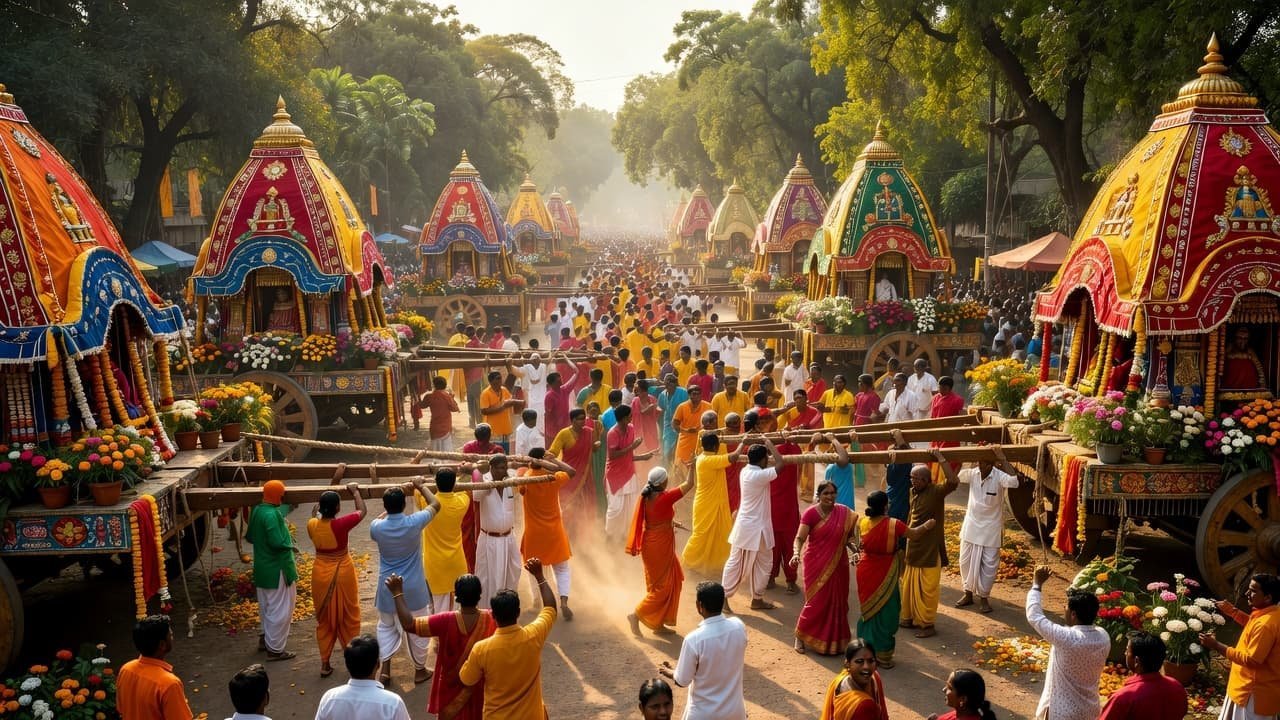
The Vaishnava teachers explain that the moods described in Sri Rupa Goswami’s Ujjvala-nilamani are present here. Not in a dry, academic way; they are living, dancing, getting upset, smiling, longing, and trying to bring Krishna home.
It is love with a pulse.
In Hera Panchami, the Lord’s royal world and Vrindavan’s intimate world sit side by side, and the difference is almost too beautiful to bear.
Jagannath’s ancient journey to Gundicha
The story of the festival for Lord Jagannath reaches back to King Indradyumna and his intense yearning to see Nilamadhava, a manifestation of Narayana. The king searched with a great hunger of heart, wanting darshan and seeking to meet the Lord he had heard about. In his quest to honor the Divine, he helped establish the spiritual significance of Jagannath Puri as a destination for pilgrims worldwide.
Nilamadhava revealed that He would not remain visible in that specific form. Instead, the king was told to go to the shore at Jagannath Puri, where a new form would appear. Logs arrived from the ocean, and a mysterious carpenter shaped the divine forms of Lord Jagannath, Lord Balabhadra, and Devi Subhadra.
King Indradyumna was surprised. Where was the original form he had sought?
Yet the Lord made it clear that this was His desire. He wished to be worshipped in this particular form, and the festivals of Snana Yatra, Rathayatra, the stay at the Gundicha Temple, and the return journey were set in motion. Over the centuries, these traditions were further refined and formalized by rulers such as King Kapilendra Deb.
The Srimandir carries the mood of Dvaraka, the royal city of Krishna. While the Gundicha Temple is not geographically Vrindavan, in this pastime, it is viewed as such. The chariot journey represents the siblings moving from a place of majesty toward a place of sweetness.
Sri Chaitanya Mahaprabhu saw Radha’s longing
Others may see Lord Jagannath as Dvarakadish, the kingly Krishna of Dvaraka. Sri Chaitanya Mahaprabhu, however, saw Lord Jagannath through the eyes and heart of Srimati Radharani.
This is where the Rath Yatra becomes so deeply intimate.
Mahaprabhu arrived with two purposes held together in one golden form. Internally, Krishna longed to taste the depth of Radha’s love. He wanted to know the sweetness she tastes in Him, including His beauty, His flute, His affection, and His playful pastimes. Externally, He came to give the rare gift of vraja-gopi-prema, which is the love held by the gopis of Vrindavan.
Krishna knows the past, present, and future of every living being, yet when He stands before the intensity of Radha’s love, He becomes hungry to understand it. Her love is so complete that Krishna Himself wants to enter it. This philosophical yearning serves as the backdrop for the Hera Panchami festival, which highlights the profound emotional distance and longing between the Lord and His devotees.
The Bhagavatam paints Vrindavan as a place where all are moved by the sound of Krishna’s flute. Deer pause, rivers swirl, and birds become still. The trees are so gentle that when parrots faint in ecstasy, their soft leaves catch them before they fall.
And Radha? Her longing is even greater. There is a prayer in which she wishes she could become Krishna’s bamboo flute, even as an unconscious piece of bamboo, simply so He would keep her near His heart.
Why Dvaraka cannot replace Vrindavan
Krishna’s departure from Vrindavan is never an ordinary departure. In the eternal pastimes, Krishna and Radha do not simply walk away from Vrindavan as we might leave a town after breakfast. There are other manifestations, other moods, and other scenes of separation.
At Kurukshetra, after a long separation, Radha sees Krishna again. But He is dressed as a king, surrounded by chariots, horses, jewels, commanders, Lord Balabhadra, and Devi Subhadra. Krishna is there. Radha is there. Still, her heart aches for the forest paths, the Yamuna, the peacock feather, the flute, and the simple boy who herds cows.
That is the ache within Rathayatra.
Lord Jagannath is Krishna in Dvaraka, and the chariot becomes the heart and mind of Radha and the gopis drawing Him back toward Vrindavan. Krishna even makes an excuse, saying He is unwell and needs a change of place. Lakshmi-devi is told that Lord Balabhadra and Devi Subhadra will accompany Him when He leaves the Srimandir, so there is no need to worry.
But five days pass.
Lakshmi knows something is up.
Lakshmi-devi comes looking for her Lord
Goddess Lakshmi does not sit in a corner wearing plain clothes and weeping. During Hera Panchami, she asserts her divine position with regal elegance. After seeking permission from Bimala Devi within the temple complex, Mahalaxmi prepares to depart. She travels in a magnificent palanquin as part of a grand procession, moving with the royal splendor befitting her status as the queen of the Lord.
Her associates, the servitors of the temple, arrive at the Gundicha temple and demand an answer: Where is the Lord, and why has He stayed away so long? In a display of divine determination, the goddess even breaks a piece of the Nandighosha chariot. Eventually, the Pati Mahapatra servitors step in to mediate, offering her the Agyan Mala, a divine garland sent by Lord Jagannath to appease her. As part of this sacred ritual, the application of Mohana Churna, a special sacred powder, signifies the restoration of harmony. Throughout this entire pastime, the golden idol of the goddess captures the hearts of all devotees.
Sri Chaitanya Mahaprabhu and His intimate devotees, including Svarupa Damodara, watch this scene at the Lion Gate. Their conversation turns toward mana, the loving sulky mood that arises in divine love.
Lakshmi’s mood carries the grandeur of Dvaraka. It has majesty, pride, royal beauty, and a little righteous outrage. The gopis’ mood is something else. Their love is so condensed, so entirely fixed on Krishna, that it controls Him.
The contrast can be held simply:
- In Dvaraka, the queens’ love is exalted, yet it is shared within a royal household and family life.
- In Vrindavan, the gopis’ love has no other center. Krishna is held captive by it.
- Radha’s mana may appear without an outer reason, yet it is only there because she knows it gives Krishna more happiness.
Krishna may have to beg Radha’s friends for permission even to see Her. In some groves, He cannot simply enter as He pleases. Imagine that. The Supreme Lord waiting at the door, hoping a sakhi might soften.
Vrindavan has more than wealth
One devotee in the discussion praises the grandeur of Dvaraka. There are palaces, golden thrones, royal clothing, and endless jewels. By comparison, the life of Krishna in Vrindavan seems simple. He carries a flute, a peacock feather, and dust on His feet, often walking without even shoes.
Svarupa Damodara answers that Vrindavan is not lacking in opulence. Its trees are kalpa-vriksha, able to fulfill every desire, and its cows are kamadhenu. Even the ornaments of the residents are made of chintamani, which are touchstones of limitless worth.
Yet, no one in Vraja is interested in cashing any of it in. The flowers are gathered only to decorate Krishna. The ankle bells are meant for dancing with Him. The cows provide milk, yogurt, butter, and, most importantly, affection. The sweetness of this connection is so overwhelming that the opulence disappears from view. Much like a mountain of sugar mixed with a tiny pinch of salt, all that is tasted is pure sweetness.
This is naravat-lila, the human-like play of Krishna. When Krishna lifts Govardhan Hill, His friends bring their sticks to help, and the gopis worry that the hill might fall on their beloved boy. Nobody pauses to say that He is God and will manage. Love has made Him their Krishna, and the ritual of this daily devotion defines their existence.
Even Goddess Lakshmi struggles to grasp this dynamic. Her own austerities to enter the rasa dance reveal the same point. She longs to join the circle, yet she cannot take up the simple gopi life, be born in Vraja, marry a cowherd, leave everything for Krishna, or make cow-dung cakes. The festival reminds us that Vrindavan asks for a particular kind of surrender, one where the heart values love far above the divine status of the Lord.
Frequently Asked Questions
What is the significance of Hera Panchami in the Rath Yatra festival?
Hera Panchami occurs on the fifth day of the chariot festival, marking the moment when Goddess Lakshmi arrives at the Gundicha Temple to express her concern and love for Lord Jagannath. It highlights the divine drama of longing and separation, emphasizing the Lord’s connection to His devotees.
Why does Goddess Lakshmi display ‘fury’ during the procession?
The display of mock fury is a traditional way of expressing her divine ‘mana,’ or loving sulkiness, because the Lord has remained away from the temple longer than promised. It is not an act of anger, but a display of the intense, personal affection and possessiveness that characterizes their relationship.
What does the comparison between Dvaraka and Vrindavan represent?
This comparison explores the difference between the Lord’s regal, majestic opulence in Dvaraka and the simple, heart-centered intimacy found in Vrindavan. The festival suggests that while Dvaraka offers splendor, the sweetness of the love found in Vrindavan is what truly captures the heart of Krishna.
How did Sri Chaitanya Mahaprabhu perceive the Hera Panchami festival?
Sri Chaitanya Mahaprabhu viewed the festival through the lens of Srimati Radharani’s feelings, seeing Lord Jagannath’s journey not as a simple move, but as a symbolic return toward the intimacy of Vrindavan. To Him, the festival represented the ultimate surrender and the unconditional love that binds the soul to Krishna.
Let the sweetness bring you home
Hera Panchami does not dismiss Lakshmi-devi or the beauty of Dvaraka. It lets us see their splendor, then shows something even more tender: a love so free of calculation that Krishna longs to return to it.
This is Mahaprabhu’s gift. It is not about accumulating more status or seeking another crown for the mind to wear. It is about fostering more soul, more love, and a deeper remembrance of the flute of Krishna calling everyone home. As we reflect on these pastimes, we prepare our hearts for the upcoming Bahuda Yatra, the return journey of Lord Jagannath that completes this sacred cycle.
Even if these pastimes feel far beyond us, hearing about the significance of Hera Panchami is already a small opening in the heart. It provides a little fragrance from Vrindavan and a little pull of the chariot rope, inviting us to find our own way back to the source of all sweetness.

TLTRExcerpt
TLTR
Excerpt
Discover Hera Panchami’s meaning during Rath Yatra, as Goddess Lakshmi seeks Lord Jagannath and Chaitanya Mahaprabhu sees Radha’s longing for Krishna.
Recent Posts

Remembering Srila Prabhupada Among the Trees On His Appearance Day
A Dying Squirrel Heard the Hare Krishna Maha-Mantra
When Coyotes Join the Hare Krishna Maha Mantra Chant
Can Rabbits Hear the Hare Krishna Maha Mantra? One Evening Chant in Southern Ontario
We Chanted With Seals, Then Nearly Burned Our Toes
Categories
Share
Recent Posts