Sacred Vedic Arts
What happens when you’re a spiritual seeker trying to trust Krishna, but life still looks empty? No food in the kitchen, grief in the heart, questions you can’t tidy up with a spiritual slogan. Sacred Sunday holds space for all of it, with kirtan, prayer, laughter, scripture, and the honest little cry that sometimes comes up: “Why, Krishna?”
The royal secret of chapter 9 is that trust in Krishna can coexist with hardship. The answer isn’t to pretend that life is always soft. It’s to keep chanting, keep serving, and let faith grow one small breath at a time.
Key Takeaways
- Bhagavad Gita 9:22 promises that Krishna carries what sincere devotees lack and preserves what they have, but this is not a guarantee of unlimited material comfort.
- The story of the brahman shows Krishna’s care through both practical provision and the removal of spiritual doubt.
- Devotion grows through humble, steady practices such as chanting the maha-mantra, serving others, reading scripture, and keeping good spiritual company.
- Trusting Krishna does not mean abandoning responsibility; we make sincere effort while relying on Him for guidance and spiritual strength.
- Faith during suffering is not the absence of questions. It is the choice to return to remembrance, prayer, and the holy name even when answers remain incomplete.
A Sacred Sunday Filled With Kirtan
The gathering moves in that sweet, unhurried way kirtan gatherings often do. There are soft bells, devotional instruments, call-and-response singing, prayers, and the repeated holy names:
Hare Krishna, Hare Krishna, Krishna Krishna, Hare Hare, Hare Rama, Hare Rama, Rama Rama, Hare Hare.
This isn’t music playing in the background. The singing is the gathering itself. Voices return again and again to Krishna’s names, giving the mind somewhere to rest beyond its usual looping thoughts.
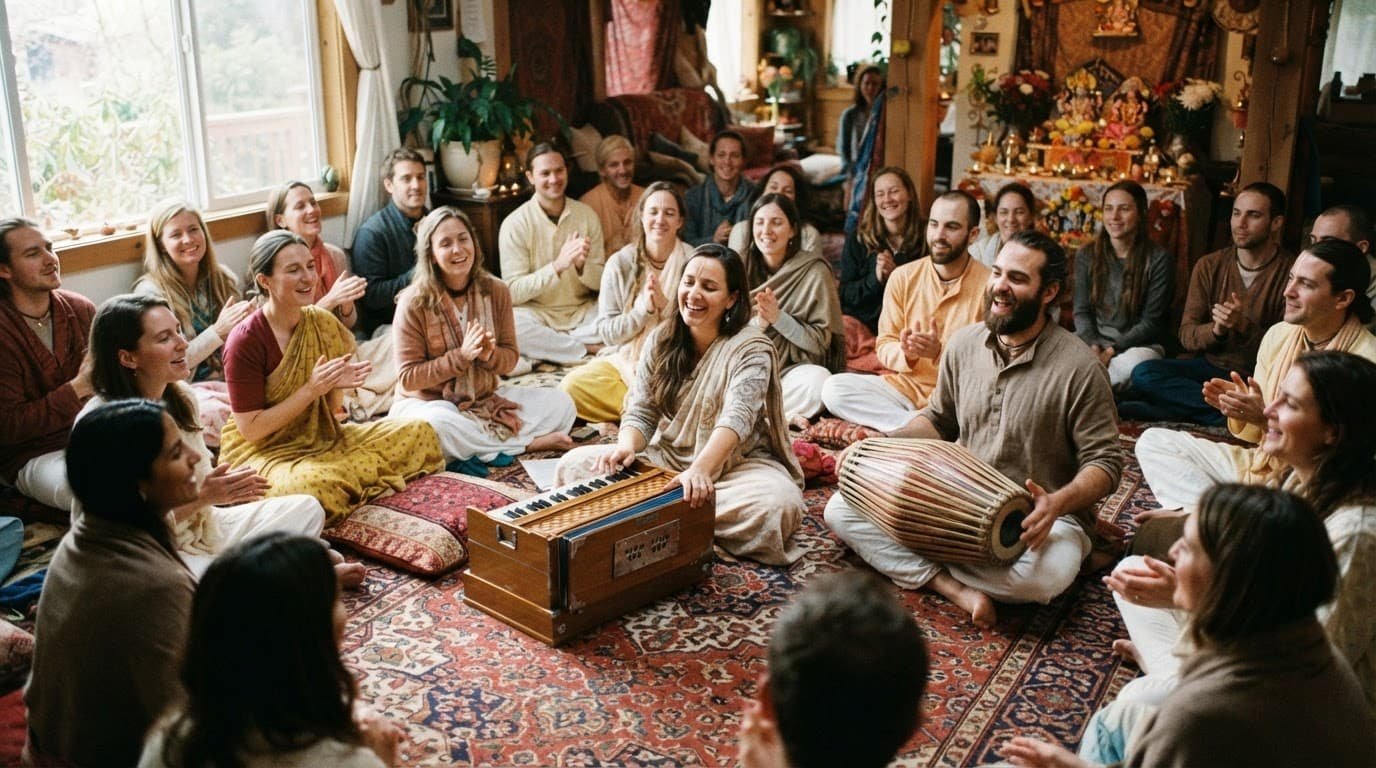
There are many ways to approach God, along with many prayers and moods. But the maha-mantra is beautifully simple. You can chant it while driving, washing pots, walking somewhere, or lying awake while the mind performs its late-night circus.
Humility Makes Space for the Holy Name
One of the prayers offered during the program asks the spiritual master for “a drop of mercy.” It is an intimate prayer, a plea for divine grace rather than a polished or proud request. The devotee asks to become more humble than a blade of grass, more tolerant, free from vanity, and able to give proper honor to every living being.
That prayer connects devotion with how we meet other people. Devotion to god isn’t only about spiritual feelings; it is expressed through humility, tolerance, and respect for every living being.
The prayer asks for:
- The strength to tolerate life’s difficulties without becoming hard-hearted.
- Freedom from the vanity that makes everything revolve around “me” and “my problem.”
- The ability to honor all living beings according to their place.
- A heart that can chant the holy names with fewer offenses.
Another reading gives voice to an even more raw confession. The mind is absorbed in material pursuits. Sense gratification has made the person blind. Maya is pictured as a witch who has tied a noose of desires around the neck.
It’s not exactly a flattering self-portrait. But it is honest.
Without the mercy of saintly people, the reading says, there is no way to overcome Maya.
The guru is remembered as someone who doesn’t sit around collecting everyone else’s faults. The guru sees a fallen person and offers shelter. For a person who feels spiritually unqualified, that mercy becomes everything.
Nityananda, Chaitanya, and a Heart That Can Soften
A song in praise of Nitai and Gauranga, Lord Nityananda and Lord Chaitanya, calls them the most merciful. They are praised as the crown jewels of all avataras and the source of spiritual happiness.
The invitation is tender but direct: let go of the obsession with material enjoyment, take shelter, and chant Hari’s name with ananya bhakti, or single-minded devotion.
The song uses rich devotional imagery. Birds and animals cry upon hearing Their glories. Even stones melt. This isn’t a scientific claim to argue over. It is the language of a heart overwhelmed by mercy, trying to say that divine love can soften what seems impossible to soften.
Another prayer welcomes Lord Krishna into the “temple of my heart” day and night. Love, garlands, sandalwood, and arati are offered inwardly. The speaker shares a beautiful teaching heard from a guru: the holy name is a person.
So the morning prayer becomes personal: “Sri Krishna, please come into my heart. I will prepare a cushion for You. I will decorate it with flowers. I will serve You.”
Not a vague force. Not an abstract idea. A relationship. Through that relationship, service becomes a path toward self-realization and liberation, grounded in love rather than abstract achievement.
The Brahman’s Doubt and Bhagavad Gita 9:22
The discussion centers on a story from Essence of Bhagavad Gita, a devotional commentary on chapter 9’s royal secret. It presents divine care as connected to sincere devotion, not a guarantee of unlimited material comfort.
It tells of a learned brahman who studied scripture and chanted Krishna’s names. He wrote realizations on the Bhagavad-gita so ordinary people could understand it.
He and his wife lived simply. He begged for about one hour each day, and they ate whatever came. They had no interest in wealth. Still, their home was painfully bare. At one point, the wife had only one garment, and the brahman tore off a portion so he could cover himself before going out to beg.
Then he came to a Sanskrit shloka. Its verse translation reads:
“But those who always worship Me with exclusive devotion, meditating on My transcendental form, to them I carry what they lack and preserve what they have.”
The key word meanings of yoga kshemam vahamyaham are simple. Yoga and kshema describe obtaining what is lacking and preserving what is already present. The story gives that promise a tangible form in the food the boy carries.
The commentary treats the brahman’s doubt as central, though acharyas may explain some details differently. He could accept that Krishna might inspire someone else to help a devotee. But Krishna Himself carrying supplies? No, he thought. How could that be?
His home had no food, no proper water pots, or supplies for the day. So, with a red pen, he crossed out the verse.

While he was out begging unsuccessfully, a beautiful dark-complexioned boy in yellow cloth arrived at his home. He carried a pole with bags of rice, dal, ghee, spices, sugar, vegetables, and more.
The boy told the brahman’s wife that her husband had sent him. He was sweating under the weight, and he showed her scratches on his back. She became upset with her husband. What kind of man would load all that onto such a tender boy?
When the brahman finally returned empty-handed, he knew nothing about the visitor. The couple searched the home, but the boy was gone. Only a thread of yellow cloth remained where he had sat.
Then the brahman opened his Gita. The red mark had vanished.
Krishna had personally carried what they lacked.
What Krishna May Be Carrying for Us
The discussion doesn’t turn this story into a promise that every devotee gets whatever material thing they want. That would be a funny kind of bhakti, right? “I’ll serve You, Krishna, as long as You keep my shopping list moving.”
The deeper question is: what do we truly lack, in material and spiritual terms?
The brahman appeared to lack food. Yet his deeper lack was faith. Krishna arranged the food, but He also removed the doubt that stood between the brahman and fuller surrender.
The story points toward exclusive devotion, not a bargain in which Krishna must fulfill every item on our shopping list. Sometimes what we lack is spiritual association. Sometimes it is steadiness in sadhana, the strength to continue, the humility to ask for help, or the taste to keep chanting. Krishna cares for a devotee’s spiritual welfare while maintaining everyone, even the cats someone feeds down the street. A devotee begins to recognize divine providence in that ordinary care.
Absolute reliance on Krishna doesn’t mean passivity or permission to abandon practical duties. The speaker shares her own experience of working in a restaurant that served meat when she first began practicing Krishna consciousness. She didn’t irresponsibly abandon her life overnight. She approached the situation through karma yoga, combining honest work, prayer, patience, and service. Another opportunity came.
We make our effort, honoring personal responsibility. Krishna shows the path.
Faith During the Hard Parts of Life
It is easy to talk about faith when things are going well. It gets harder when tragedy arrives, when a loved one dies, when the world looks cruel, loud, and broken up like a street under demolition.
The reflection includes grief over an earthquake in Venezuela and the unbearable loss experienced by a friend. There are no neat answers for suffering like that. Karma may be part of the Vedic understanding, but pain still hurts. Divine protection isn’t immunity from earthquakes, death, or injustice. It can be spiritual shelter and guidance, preserving a person’s connection with Krishna amid suffering.
A person can know philosophy and still ask, “Where is the mercy?” That question doesn’t disqualify anyone from devotional life. The brahman questioned. Arjuna questioned on the battlefield. Arjuna looked at relatives on both sides and could not imagine how to remain composed.
Krishna’s instruction was not to become numb. It was karma yoga, remembering Him and acting in service.
The maha-mantra can become a little thread back to that remembrance. Unshakeable faith isn’t the absence of questions; it’s returning to remembrance and chanting when answers remain incomplete. Chant it long enough, with care about what else you place in the heart, and it starts showing up on its own. In the morning. Before sleep. In the car. In the middle of a day that has gone sideways.
Keep the Name Close
Sacred Sunday doesn’t ask for some impossible display of spirituality. No need to climb Mount Everest, become perfect by Tuesday, or pretend you don’t have doubts.
Chant when you can. Read a small book. Offer what you have. Serve where you can. Speak about Krishna with someone. These simple acts are karma yoga when offered with love. Keep company with people who remind you where you want to go.
Choosing these small practices is personal responsibility, not self-punishment. Repeat them with gentle inner discipline. The distance between where you are and where you hope to be may not disappear overnight. Still, if that distance starts getting smaller, even a little bit, something beautiful is happening.
Frequently Asked Questions
What does Bhagavad Gita 9:22 mean by “I carry what they lack”?
Krishna promises to care for those who worship Him with exclusive devotion, providing what is genuinely needed and preserving what supports their spiritual path. The verse is not a promise that every material desire will automatically be fulfilled.
Does this verse mean devotees will never experience hardship?
No. The article explains that devotion does not create immunity from grief, illness, injustice, or practical difficulties. Krishna’s protection may appear as spiritual shelter, guidance, strength, or the people and practices that help a devotee continue.
What is the story of the brahman meant to teach?
The story shows Krishna personally providing food for a devotee who doubted the meaning of Bhagavad Gita 9:22. It also suggests that Krishna carried away the brahman’s deeper lack: his inability to fully trust divine care.
How can someone practice this teaching in daily life?
Keep the holy name close through chanting, prayer, scripture, service, and spiritual association. Make practical efforts and honor personal responsibilities while trusting Krishna to guide the path and provide the strength needed for the next step.
Krishna Is Already Near
The promise of Bhagavad Gita 9:22 is not an invitation to make Krishna our supplier. It is an invitation to trust that He knows what the heart needs for its return to Him.
The Sanskrit expression yoga kshemam vahamyaham points to this care. The acharyas understand it as care for the devotee’s genuine needs, not automatic fulfillment of every desire. Sometimes Lord Krishna carries rice and dal, faith, a person, a mantra, a book, or strength for one more round of chanting.
Keep the holy name near. Krishna is not far from a sincere call. This is the royal secret: trust His care and keep the holy name near.

TLTRExcerpt
TLTR
Excerpt
Bhagavad Gita 9:22 explains how Krishna cares for sincere devotees through hardship. Explore the brahman’s story, chanting, and trust without easy promises.
Recent Posts

Remembering Srila Prabhupada Among the Trees On His Appearance Day

A Dying Squirrel Heard the Hare Krishna Maha-Mantra

When Coyotes Join the Hare Krishna Maha Mantra Chant

Can Rabbits Hear the Hare Krishna Maha Mantra? One Evening Chant in Southern Ontario

We Chanted With Seals, Then Nearly Burned Our Toes
Categories
Share
Recent Posts